Saturday, April 7, 2012

G: The Guernsey Literary and Potato Peel Pie Society, The Ghost Brigades, The Giant's House

This is becoming a (bad) habit. I dug through all my print books, then realized just before midnight that the reason I couldn’t find my print copy of Guernsey was that I don’t have one. But I do have an archived ebook. Grrr.

Guernsey Literary & Potato Peel Pie Society byAnnie Barrows & Mary Ann Shaffer
Genre: historical, general/literary


This book combines elements I wouldn’t have thought could be combined in one book. I certainly would never have picked it up on my own, but my “literary” book club read it, and I’m glad we did.

General premise: In a series of witty letters, it tells the story of some Guernsey folk who formed a book club while under Nazi occupation. Guernsey is an island between England and France, and I believe was the only part of the United Kingdom actually occupied by the Germans during WWII. Much like the kids in the Narnia books (I'm assuming people are more likely to be familiar with those than with English history), the kids on the island were evacuated to live with strangers in England just before Guernsey was attacked.

The word I’ve heard used most often to describe this book is “charming”. And it is. It’s amazing that one could maintain such a lighthearted, humorous tone in a book about people trying to hold onto something approaching a normal life while starving alongside ill-supplied invading forces and watching their neighbors be carted off to concentration camps. I’m not describing it very well. Just give this amazing book a shot.
 
The Ghost Brigades by John Scalzi
Genre: SF


General premise Jared Dirac is a member of a unique military unit nicknamed the Ghost Brigades, cloned from the DNA of dead recruits and then seriously genetically enhanced. Unlike the others, Jared was cloned from a living person, Charles Boutin, who has defected to the enemy with secrets the Colonial Defense Force is desperate to keep. At first Jared seems like a failed experiment as he has none of Boutin's memories, but slowly they start to filter into his brain, creating conflict between the viewpoint he inherited with his DNA and the soldier he has to be.

The Ghost Brigades comes after Old Man’s War and is one of my favorite SF books. I believe it’s the only SF that’s made me cry (and no, that’s not why I love it). When people who have never really read science fiction ask for recommendations, I suggest Ender’s Game (profiled earlier) and Old Man’s War.

The Giant’s House by Elizabeth McCracken
Genre: literary/general fiction


The general premise is daring – a twenty-five-year-old librarian named Peggy (who fits all the stereotypes of a librarian, except for her sly wit) falls in love with one of her students. James, like Peggy, is a lonely misfit. When she first meets him, he’s eleven years old, already 6’4”, and would never stop growing.
There are plenty of stories about men falling in love with inappropriately-young women. Very rarely do we see the reverse, and the author wrote a fascinating story without going anywhere gross with it, focusing more on the growth and tragedy both characters experience over the course of a decade as giantism takes its toll on James.


Friday, April 6, 2012

F: The False Prince, Firefly and Freakonomics

The False Prince by Jennifer A. Nielsen
Genre: fantasy


I actually bought this in hardback while browsing through a store last week. I don’t remember the last time I bought fiction that way (I still buy print books, but usually nonfiction for research, sometimes from Bookins (a book swap website), but I loved the concept of The False Prince so much I was afraid I would get home and find out it wasn’t available on kindle.

First the General premise: The royal family has been murdered, and soon the nobles will no longer be able to keep it a secret. To avert a civil war, a nobleman named Conner finds four orphans who look like the younger prince (who disappeared many years before, believed to have been ambushed and killed by pirates). Connor’s plan is to train all four to impersonate the prince. Whoever does it best will gain the throne and a life far beyond what a child from an orphanage can imagine. The others won’t live long enough betray the plot.

Jennifer Nielsen didn’t disappoint, y’all. She handled her plot (and her plot twists) deftly, and the book is imbued with all the fast-paced freshness one expects of young YA. YA has gotten really dark lately. That’s fine, but that makes books like this so much more special. I highly recommend it.

And then there’s
Firefly created by Joss Whedon
Genre: Television SF

Joss Whedon is, of course, the creator of Buffy the Vampire Slayer, Angel, and Dollhouse. He also wrote and directed the movie adaptation of The Avengers, coming out later this year.

Firefly is the greatest television show ever, so amazing that even after it was canceled, overwhelming fan support led to Serenity, a movie based on the show. According to Wikipedia (the only place I could find all the awards listed together), “Serenity won film of the year awards from Film 2005 and FilmFocus. It also won IGN Film's Best Sci-Fi, Best Story and Best Trailer awards and was runner up for the Overall Best Movie. It also won the Nebula Award for Best Script for 2005, the 7th annual "User Tomato Awards" for best Sci-Fi movie of 2005 at Rotten Tomatoes, the 2006 viewers choice Spacey Award for favorite movie, the 2006 Hugo Award for Best Dramatic Presentation, Long Form and the 2006 Prometheus Special Award.“
And, IMO, Serenity wasn’t even as good as the TV show it was based on (or maybe I’m just mad at Joss Whedon for killing off my favorite character in the movie).
I would say more, but thinking about the fate of Firefly, which was canceled before its first season even ended, depresses me (for comparison, the reality TV show Jersey Shore is entering its sixth season. Sixth. Words fail me).

Besides, the very fact that Firefly couldn’t be reduced to a pithy sentence or two was the beginning of its marketing problems. So I’ll just post a picture of The Official Companion, Volume One (it has the scripts, which I reread when I’m looking for something with great dialogue) and give it a tearful moment of silence…

Yes, that's Nathan Fillion, currently starring in Castle
…There.

One more F book!
Freakonomics by Steven D. Levitt & Stephen J. Dubner
Genre: nonfiction (economics/psychology)

Written by an economist and a journalist, it was getting lots of press when I read it a few years back. What I liked most about it was the authors’ way of looking at the same scenarios as everyone else, but seeing them from a completely different perspective. It wasn’t necessarily the conclusions they drew (which were always unconventional) but the process they went through to arrive at those conclusions that fascinated me.
Some of the questions they addressed: Which is more dangerous, a gun or a swimming pool? What do schoolteachers and sumo wrestlers have in common? Why do drug dealers still live with their moms? How much do parents really matter? How did the legalization of abortion affect the rate of violent crime?

And that's it for F!

Thursday, April 5, 2012

E: Ender's Game and Ender's Shadow

I’m a sucker for books about brilliant, analytical kids. I also love books that cover the same plot and characters from dramatically different points of view, which is what we get today.

As it turns out, I can't find my copy of Ender's Game. That's all right - it's probably the most famous "accessible" science fiction novel (as opposed to famous SF books written by people clearly more interested in physics and engineering than in garnering a large readership), so I don’t need to say much about it.

I do, however, have Ender's Shadow in front of me - in print, no less. I'm the only person I know who prefers Ender's Shadow to Ender's Game. Still, I (and many millions of readers) think they're both great books.

Now that The Hunger Games has managed to put kids killing kids on the big screen and get a PG-13 rating, maybe we'll finally see an Ender's Game movie. Though as far as I know, Orson Scott Card didn't intend Ender's Game to be MG or YA. It ended up being marketed as such because of his writing style and the age of the protagonist.

Ender’s Game by Orson Scott Card
Genre: science fiction


Ender's Game doesn't need much introduction, but I'll give it a shot: Earth has been warring with a hostile alien race for about a hundred years, and needs to decisively end the conflict before the aliens come back and wipe out the population. As part of the plan, the smartest kids on the planet are selected for Battle School (in a ship orbiting the earth - though I guess it's technically a satellite if it's permanently in orbit? Wow, this is hard to do when I can't just flip through the book).

Ender is the smartest of those kids, but he's also among the youngest and smallest, making him an easy target for bullying. And while he's up there playing battle games and figuring out how to save everyone, his older brother and sister (also very young and ridiculously smart) are back home, setting themselves up to take over the world.

Ugh. That's the last time I sum up a book I can't look through to refresh my memory.

Fortunately! I also have

Ender's Shadow by Orson Scott Card
Genre: science fiction


Maybe I liked this book better because I read it right after reading Ender's Game, when it was in fact written over a decade later. I felt like it filled in and fleshed out all sorts of things that were just alluded to in Ender's Game. The two books cover the same time period, but...

General premise Bean, an orphan surviving by his wits on the streets of Rotterdam, is discovered by a recruiter and selected to be part of Earth's plan to defend itself from enemyaliens. Bean is easily the most brilliant student at Battle School. Too brilliant to be trusted to follow the rules and toe the line the way most of the other kids are doing.

While Ender is more preoccupied with his personal and philosophical struggles, Bean wants to know why they're all there and what the adults are hiding from them. And unlike Ender, Bean knows how to look for the truth, because he's already spent most of his life fighting for survival.

I paused to get details from the book, and now I’m 124 pages into Ender’s Shadow. Must…resist…temptation…

Wednesday, April 4, 2012

D: The Demon's Lexicon and Dragon Bones

I think this officially marks the highest number of blog posts I’ve ever made in a week, so yaaay for the A to Z Challenge!
 
Now on to two of my favorite "D" books:
 

The Demon’s Lexicon by Sarah Rees Brennan
Genre: urban fantasy


General premise Nick and his older brother Alan have spent their lives running from magicians who want the charm keeping their mother alive. When Mae and Jamie arrive on their doorstep looking for help, Nick wants to kick them out, but Alan's attempt to help leads to his being marked by a demon. Now the only way to save his life is to fight the magicians hunting them.


And
 
Dragon Bones by Patricia Brigg
Genre: fantasy


General premise For most of his childhood, Ward pretends to be less intelligent than he is, so his father won't accuse him of treachery and kill him. When his father dies and Ward becomes ruler, he learns the family secret about the power available to him from the ghost that isn't a ghost. But Ward's also played an idiot for so long that he's now a target for nobles who think he's incapable of ruling.


I love both of them, but these two protagonists couldn’t be more different. Nick seems like a psychopath at first glance. I believe the author of The Demon's Lexicon said that her idea with Nick had been to write the hot, bad boy that is so common in fiction, without giving him a fairy-tale heart of gold (even though everyone around him wants to think he has a hidden, softer side). Unlike true psychopaths, Nick never lies (and therefore always keeps his word and never makes excuses), and he loves and protects his older brother Alan wholeheartedly. With Nick, what you see is what you get. At least, until you start to understand him. At which point what you see is still what you get, but now there’s nuance and shading to the stark lines of his personality and world view.
 
Ward, on the other hand, spends a good chunk of the book sacrificing himself for other people, and has cultivated a persona of being both nice and a little slow, so that no one ever actually knows what he’s really like. People don't think he's smart enough to have hidden his real self all those years, and he finds out the hard way that getting a reputation is much easier than changing one.

Both books have humor to balance dark circumstances, great sibling relationships and fascinating family problems. And Patricia Brigg’s unique take on the “family ghost” in Dragon Bones deserves special mention. Writing this reminds me how long it's been since I reread it. If I didn't have a bunch of blog posts to write (and a few letters to read books for asap - K, P, Q, X, Y, and Z, to be exact), I'd reread Dragon Bones right now...

Tuesday, April 3, 2012

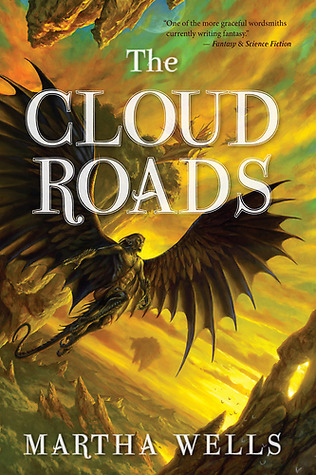
C: The Cloud Roads

Another favorite!

The Cloud Roads by Martha Wells
Genre: fantasy


Most Fantasy novels have pseudo medieval-European settings. That's fine, but The Cloud Roads is nothing like that, and it's brilliant. Along with an awe-inspiring world, Martha Wells captures perfectly the pain of being lonely and different. And how being surrounded by others who are "just like you" (who really don’t understand you at all, and who you certainly don’t understand) can make that pain so much worse.

General premise Moon’s learned the hard way not to trust anyone. In his flying form, he looks too much like the Fell, who destroy cities and eat their inhabitants. When his neighbors stake him out for death, he's rescued by Stone, the first person he's met who looks like him. Not only can Stone answer all of Moon’s questions about himself, but Stone truly seems to want him around, a rare experience in Moon’s life. Intrigued and relieved not to be alone anymore, he agrees to move to Stone's settlement.
But looking like his kind doesn't mean Moon fits in. He doesn't know the things he should, doesn't do the things they do or like what they like. Worse, Stone led him to believe he was a warrior-type, but Moon finds out in an epic showdown that he's actually a consort. The reigning queen hates him for tipping the balance of power in her young rival's favor, and the challenger keeps leaving gifts for him that he's afraid will mean he owes her something it will cost him too much to repay. Moon isn't interested in power struggles - he has enough problems of his own. But the Fell intrude on his new life, too, and fighting them is the only option.

This series (the second book is The Serpent Sea; The Siren Depths comes out in January 2013, and I really hope that's not the last) pulls together the things I love best about the major “grade levels” of books. Middle grade books are written for an audience that hasn’t yet restricted its imagination and possibilities and gender into rigid boxes. YA deals exquisitely with emotions and coming-of-age stories. Adult fiction doesn’t shy away from pain or suffering or other difficult themes. Martha Wells combines all these in the Books of the Raksura, and does it in a way that just leaves me awestruck.

Monday, April 2, 2012

B: The Black Prism & Bitterblue

The Black Prism by Brent Weeks
Genre fantasy


I’ve blogged about this book before, but you can't recommend a great book too many times. If you’re looking for what the Fantasy genre does best (Adventure! Politics! Magic!) without the things Fantasy has depressed us with too many times (Predictable quest! Misogyny! Racism!), this is the book for you.

General premise Kip’s village is attacked, and just before his mother dies, she gives Kip an exquisite dagger and tells him to avenge her. On the other side of the world, Gavin Guile, the most powerful drafter (or color magician) in the world, learns he has a son, and swoops in to save Kip from certain death. Now Gavin has to protect his new-found son from political enemies, placate his irate fiancĂ©, keep his other secret from coming out, and stop the lands from falling back into a world war. Kip has his own decision to make: obey his mother’s wishes and kill the father who abandoned them, or help his father save the lands from destruction.

Bitterblue by Kristin Cashore
Genre fantasy


When I read Graceling (Kristin Cashore’s first book – Bitterblue is her third, set in the same world), I loved it so much I flew across the country to attend a conference where Kristin Cashore was speaking. I’m the kind of introvert who prefers to stay home with the curtains drawn, pretending I didn't hear the phone ring, so this was quite an undertaking.

Incidentally, I’ve been to the Sirens Conference three times now, and they've done a brilliant job with each year's theme: Warriors, Faeries, Monsters (2012 will be Storytellers). If you want to meet authors, editors, readers and writers of fantasy by and/or about women, at a conference that’s not so large that you’re constantly lost, yet not so small that it feels like you’re the only one who doesn’t know everyone else, this is the one for you.

Since I haven’t read Bitterblue yet (available May 1st, for those of us not lucky enough to have ARCs), I’m borrowing the publisher’s description from Amazon:

"Eight years after Graceling, Bitterblue is now queen of Monsea. But the influence of her father, a violent psychopath with mind-altering abilities, lives on. Her advisors, who have run things since Leck died, believe in a forward-thinking plan: Pardon all who committed terrible acts under Leck's reign, and forget anything bad ever happened. But when Bitterblue begins sneaking outside the castle--disguised and alone--to walk the streets of her own city, she starts realizing that the kingdom has been under the thirty-five-year spell of a madman, and the only way to move forward is to revisit the past.

Two thieves, who only steal what has already been stolen, change her life forever. They hold a key to the truth of Leck's reign. And one of them, with an extreme skill called a Grace that he hasn't yet identified, holds a key to her heart."


Sunday, April 1, 2012

A: An Abundance of Katherines

For the first A to Z challenge post, I'm profiling a book that always ranks among my top five when people ask for recommendations. Oh, who am I kidding? I steer conversations so I can recommend this book. I've only read it once, though. Hilarious as it is, it's also too personally painful to reread constantly (in contrast, I've read the Hunger Games series five times).

An Abundance of Katherines by John Green


Genre YA

General premise After being dumped for the nineteenth time by a Katherine (no, not one girl playing with his heart – nineteen separate individuals named Katherine), Colin realizes it's now or never: this summer (the summer after high school graduation) is his last chance to go from child prodigy to adult genius.

Page 7 quote
Prodigies can very quickly learn what other people have already figured out; geniuses discover that which no one has ever previously discovered. Prodigies learn; geniuses do. The vast majority of child prodigies don't become adult geniuses. Colin was almost certain that he was among that unfortunate majority.

I remember shedding tears when it registered that I was too old to be a child prodigy at anything, never mind genius. I wish I were joking.

Anyway! Colin allows his high-octane friend Hassan (who is all sorts of awesome) to talk him into going on a road trip. They’ll both get what they want: Hassan avoids college for another year, while Colin works on a math theorem for predicting whether a relationship is going to end and who is going to end it. And yes, there is math in the book. But this is math about relationships. Math with real-world applications. The sort of thing we wish we'd been learning in Algebra II.

Hassan can't decide whether Colin's problem is being dumped or "the genius thing", but Colin sees them as different aspects of the same problem. As he laments to Hassan (also on Page 7), "I'm a total failure in case you haven't noticed. I'm washed up, I'm former. Formerly the boyfriend of Katherine XIX. Formerly a prodigy. Formerly full of potential. Currently full of s***."

Ah, teenage angst.

Colin's the kind of kid who, while sitting in a bathtub, recalls his four-year-old self reading about Archimedes for the first time (I was about five when I discovered the Greek myths, but I think we can all agree Herakles and Archimedes aren't exactly on the same intellectual level) and running to his mom to declare that he wanted a Eureka moment, "the way another kid might have expressed longing for a Teenage Mutant Ninja Turtle."

In case you can’t get An Abundance of Katherines right this moment, I’ll start you off with the first lines:
The morning after noted child prodigy Colin Singleton graduated from high school and got dumped for the nineteenth time by a girl named Katherine, he took a bath. Colin had always preferred baths; one of his general policies in life was never to do anything standing up that could just as easily be done lying down.